
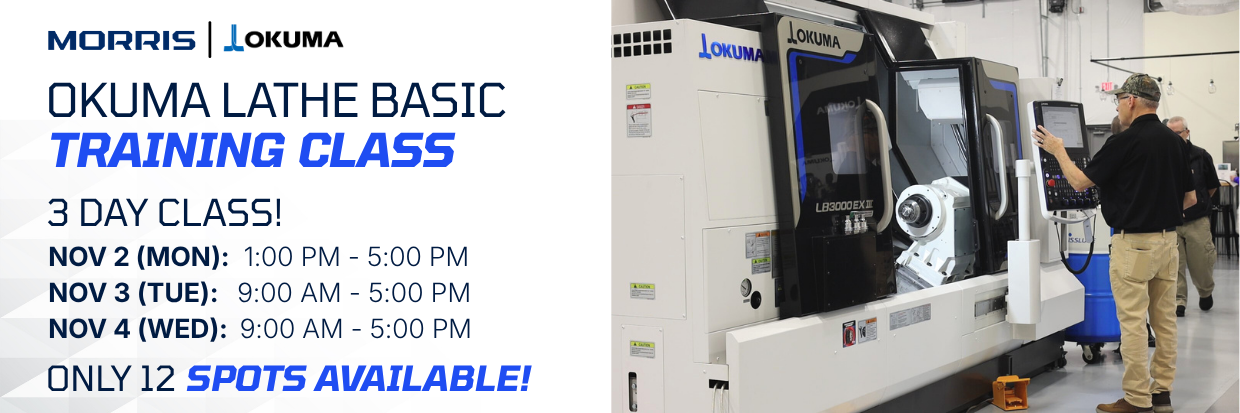
Lathe Basics Lunch & Learn FAQ
Who should attend this training?
This class is designed for CNC operators, setup personnel, programmers, manufacturing engineers, shop supervisors, and anyone looking to build a stronger understanding of CNC lathe fundamentals.
What type of machine is covered?
The course focuses on a 2-axis CNC lathe and the fundamental concepts needed to safely operate, program, and set up a turning center.
What will I learn during the class?
Across three days, attendees will learn:
- Machine and controller fundamentals
- CNC lathe components and functions
- Controller navigation and operation
- G-code and M-code basics
- Program loading and management
- Manual and MDI operation
- Tool and work offsets
- Workholding and machine setup
- Program prove-out techniques
- Troubleshooting and best practices
Will there be hands-on machine demonstrations?
Yes. The training combines classroom instruction with machine demonstrations and practical examples to reinforce key concepts.
Will I learn how to write CNC programs?
You will learn the fundamentals of CNC program structure, common G-codes and M-codes, and programming best practices for turning applications.
What should I bring?
We recommend:
- Safety glasses
- Notebook and pen
- Closed-toe shoes
- Questions and real-world challenges you'd like to discuss
What is MDI mode?
MDI (Manual Data Input) mode allows an operator to enter and execute individual CNC commands without running a complete program.
Will setup procedures be covered?
Yes. The final day focuses on machine setup, including:
- Tool offsets
- Work offsets
- Workholding
- Program verification
- Production preparation
Will machine maintenance be discussed?
Basic operator-level procedures such as startup, shutdown, lubrication checks, and coolant system operation will be covered.
What will I learn after completing the class?
By the end of the training, attendees should be able to:
- Understand the major components of a CNC lathe
- Navigate the machine controller confidently
- Understand basic CNC programming concepts
- Load and manage programs
- Set tool and work offsets
- Prepare a machine for production
- Safely verify and run programs
- Troubleshoot common operating issues