
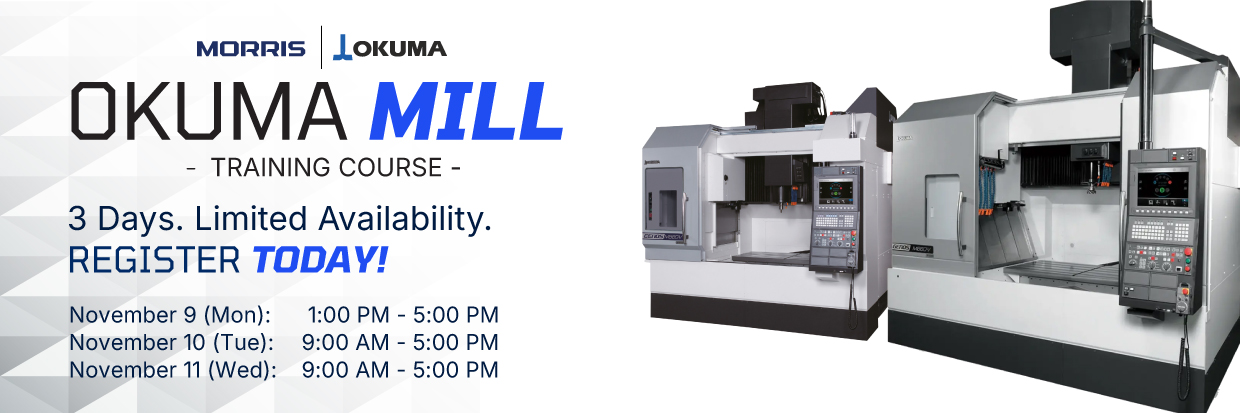
OKUMA MILL Basics Lunch & Learn FAQ
Who should attend this training?
This course is ideal for CNC operators, programmers, setup personnel, manufacturing engineers, and anyone new to Okuma vertical milling machines who wants to build a strong foundation in milling operations and Okuma controls.
Do I need previous experience with Okuma machines?
No. The class is designed for beginners as well as experienced machinists looking to gain confidence with Okuma controls and vertical mill setup procedures.
What will I learn during the class?
Topics include:
- Vertical mill fundamentals
- Okuma controller navigation
- Machine components and layout
- Basic G-code and M-code programming
- Cutter compensation
- Differences between P300 and P500 controls
- 3-axis machine setup procedures
- Running and managing CNC programs
What is the difference between the P300 and P500 controls?
The course includes an overview of both control platforms, highlighting key interface differences, navigation features, and operational considerations so users can work confidently on either system.
Will I learn CNC programming?
Yes. Attendees will learn the fundamentals of CNC programming, including common G-codes, M-codes, program structure, and programming best practices for vertical milling applications.
What is cutter compensation and why is it important?
Cutter compensation allows the machine to account for tool diameter and wear. Understanding cutter compensation helps improve part accuracy and simplifies program adjustments.
Will there be hands-on machine time?
Yes. This course combines classroom instruction with practical machine exercises, giving attendees the opportunity to apply what they learn on a 3-axis vertical mill.
Will machine setup be covered?
Absolutely. One of the key objectives of the class is learning the step-by-step setup process for a 3-axis vertical machining center, including machine preparation, offsets, tooling, and program execution.
What should I bring?
We recommend:
- Safety glasses
- Closed-toe shoes
- Notebook and pen
- Questions about your current machining challenges
What will I learn after completing the class?
By the end of the training, attendees should be able to navigate an Okuma control, understand basic CNC programming concepts, set up a vertical mill, manage CNC programs, utilize cutter compensation, and confidently operate a 3-axis Okuma machining center.